Rideshare in San Francisco Isn't Getting People out of Cars
A
study of automobile travel and traffic congestion in San Francisco, commissioned
by the San Francisco County Transportation Authority and released last month,
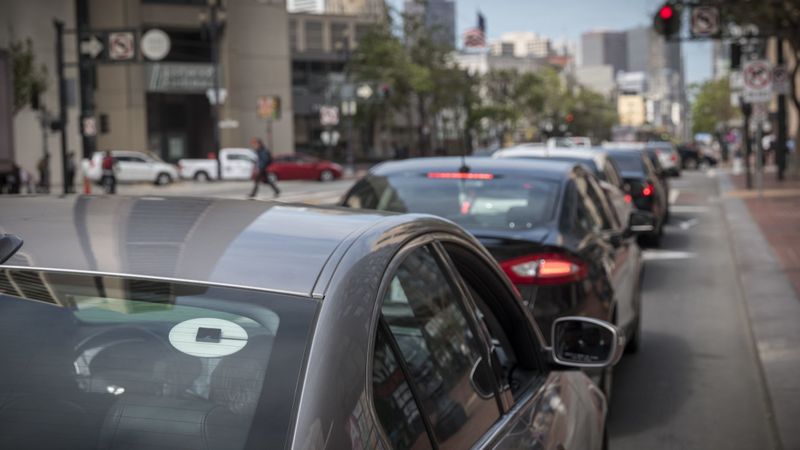
found that TNCs were responsible for a substantial share of increases to
travel delays and VMT from 2010 to 1016. Part of the reason for this outsized
contribution is the circulation of vehicles that are not carrying passengers,
as well as drivers from surrounding areas coming in to the city to drive. Pick-up
and drop-off can also increase delays by obstructing or slowing traffic.
The researchers ran a model that for a
scenario in which TNCs were not introduced during the period of study but changes
to population and employment remained the same, and found that VMT was
significantly lower. The impacts were not uniform across the city, however. Comparison
of the two scenarios—the hypothetical without TNCs and the actual with TNCs—found
that TNCs led to substantially increased delays in and around Downtown while
having little impact on outlying areas. Much of this is because the impacts of
additional vehicles are far greater in areas that are already congested than in
those that have lower traffic volumes. While the study was unable to account
for increased deliveries or tourism due to lack of data, it is not clear that
these would have varied between the two scenarios.
These results fly in the face of Uber and
Lyft’s efforts to paint themselves as part of a less auto-dependent future, and
comes in spite of their promotion of shared rides. Both companies responded
to the report by emphasizing their expansion into bike and scooter share, though
rideshare remains the core of their business. It also undermines claims that
rideshare can serve to supplement transit as a first-last-mile solution. From
this study, it would appear that rideshare, at least in San Francisco, is not
an effective means to reduce auto travel or move more people efficiently.


Comments
Post a Comment