De Nederlandse Oplossing
A new word has been making waves across the Anglosphere of urban design and transportation planning, and with good reason, as it's implications could challenge the fundamental relationships between various modes of transportation, human beings, and the spatial entity that is "the city."
Of course, the word I am referring to, as well as the concept that it represents, is none other than Woonerf.
Woonerf, Dutch for "life yard," or "living yard," is a rather common urban intervention found within the Netherlands: an absolutely egalitarian right-of-way, a woonerf is a level street without any physical or social separation of various transportation modes.
Bicyclists share the road with pedestrians, automobiles, scooters, motorbikes, horses, and the like. In a world where various modes of transportation are seen as necessitating dedicated space in order to maximize efficiency and safety, the woonerf defiantly exclaims "nee," and insists that the same goals can be achieved by simply abandoning the failed system of order that most streets attempt to adhere to, an order that many can agree is certainly not functioning as intended.
No longer limited to the Netherlands, woonerfs are found throughout Europe, and have even made their way across the Atlantic to the New World, acting as vanguards of new old urbanism, and making many question what their role could be in an uncertain future amid TNCs, MaaS, microtransit, AVs, and the like.
The core philosophy of the woonerf is one of looking backwards as essential to moving forwards: in the elimination of the modal separation that has come to define our modern cities, commuters are forced to engage with the various forms and historical stages of transportation all at once.
Many American planners site the famous "A Trip Down Market Street" film as an example of the woonerf principle, wherein safety is ironically ensured through chaos and mutual danger. When bicyclists are wary of motorists and pedestrians, pedestrians are wary of motorists and bicyclists, and so on and so forth, there is a reduction in the pace of modernity, and a totally democratic distribution of space.
Automobiles, taking up large amounts of space to often transport one individual, will be effectively "out-voted" by more mobile, compact, affordable, and accessible means of transportation, which will utilize the street in a far more efficient manner. Woonerfs are technically open to all modes, but the fear of losing dominance of the road to pedestrians and cyclists essentially drives motorists elsewhere, a keen demonstration as to how, without government provision of dedicated land for movement and storage of vehicles, the automobile is clumsy and unnecessary in dense cities filled with human beings.
With more and more microtransit vehicles on the streets and sidewalks, as well as the advent of MaaS, one might think the Age of the Woonerf is upon us. However, inasmuch as microtransit is changing up the "electoral landscape" of the street, so to speak, so are TNCs. Directly opposite microtransit, TNCs demand more space for automotive transit, rather than less. Should woonerfs be the new norm, and mobility modes left to "duke it out" in the streets? Will our mobility revolution be a democratic one, or perhaps more authoritative, and will it fundamentally change the definition of transportation efficiency and safety as we know it?
Sources/Links:
https://www.citylab.com/solutions/2015/03/6-places-where-cars-bikes-and-pedestrians-all-share-the-road-as-equals/388351/
https://www.naturespath.com/en-us/blog/woonerf-the-dutch-solution-to-city-planning/
http://www.canin.com/world-woonerf/
https://www.nytimes.com/2013/04/28/automobiles/where-share-the-road-is-taken-literally.html
Of course, the word I am referring to, as well as the concept that it represents, is none other than Woonerf.
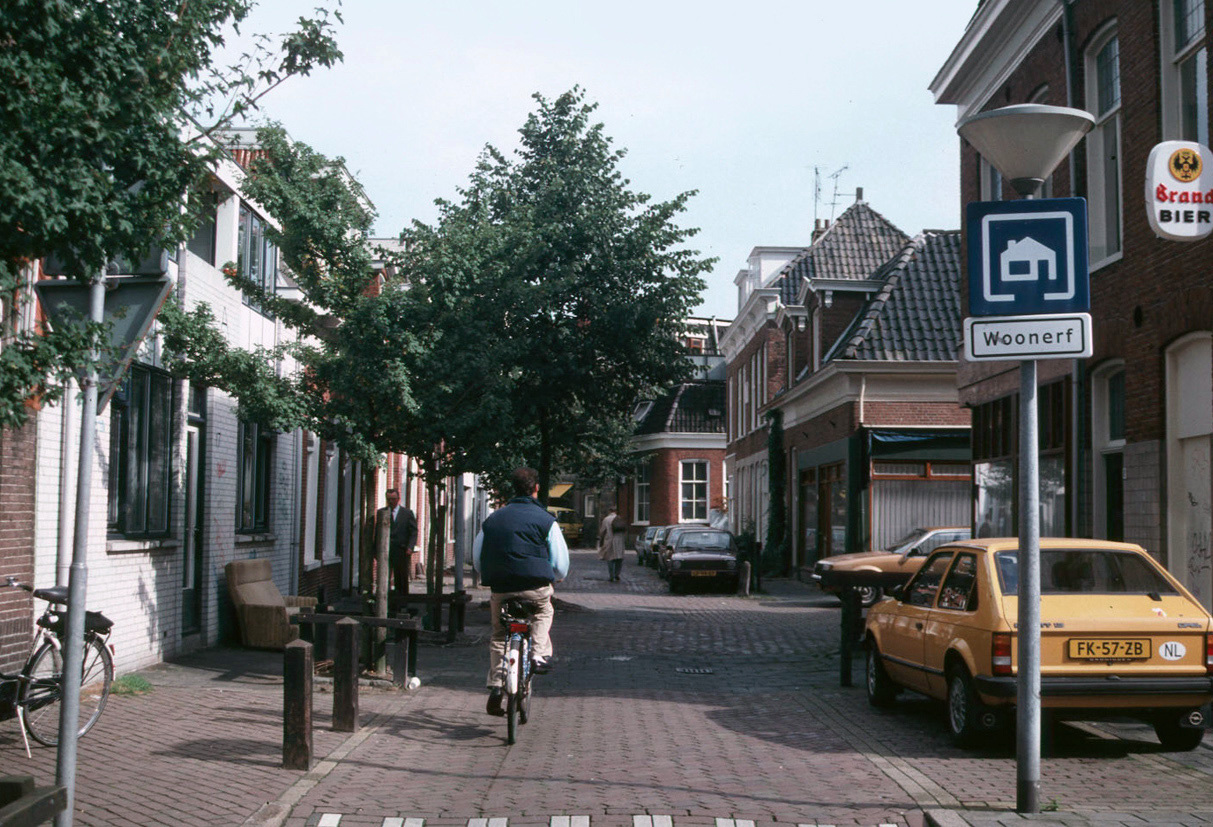 |
| A Woonerf in the Netherlands, wherein cars lose spatial majority to human beings. |
Woonerf, Dutch for "life yard," or "living yard," is a rather common urban intervention found within the Netherlands: an absolutely egalitarian right-of-way, a woonerf is a level street without any physical or social separation of various transportation modes.
Bicyclists share the road with pedestrians, automobiles, scooters, motorbikes, horses, and the like. In a world where various modes of transportation are seen as necessitating dedicated space in order to maximize efficiency and safety, the woonerf defiantly exclaims "nee," and insists that the same goals can be achieved by simply abandoning the failed system of order that most streets attempt to adhere to, an order that many can agree is certainly not functioning as intended.
No longer limited to the Netherlands, woonerfs are found throughout Europe, and have even made their way across the Atlantic to the New World, acting as vanguards of new old urbanism, and making many question what their role could be in an uncertain future amid TNCs, MaaS, microtransit, AVs, and the like.
The core philosophy of the woonerf is one of looking backwards as essential to moving forwards: in the elimination of the modal separation that has come to define our modern cities, commuters are forced to engage with the various forms and historical stages of transportation all at once.
Many American planners site the famous "A Trip Down Market Street" film as an example of the woonerf principle, wherein safety is ironically ensured through chaos and mutual danger. When bicyclists are wary of motorists and pedestrians, pedestrians are wary of motorists and bicyclists, and so on and so forth, there is a reduction in the pace of modernity, and a totally democratic distribution of space.
 |
| Still from the 1906 film "A Trip Down Market Street," showing the free use of the street to all modes of movement. |
Automobiles, taking up large amounts of space to often transport one individual, will be effectively "out-voted" by more mobile, compact, affordable, and accessible means of transportation, which will utilize the street in a far more efficient manner. Woonerfs are technically open to all modes, but the fear of losing dominance of the road to pedestrians and cyclists essentially drives motorists elsewhere, a keen demonstration as to how, without government provision of dedicated land for movement and storage of vehicles, the automobile is clumsy and unnecessary in dense cities filled with human beings.
With more and more microtransit vehicles on the streets and sidewalks, as well as the advent of MaaS, one might think the Age of the Woonerf is upon us. However, inasmuch as microtransit is changing up the "electoral landscape" of the street, so to speak, so are TNCs. Directly opposite microtransit, TNCs demand more space for automotive transit, rather than less. Should woonerfs be the new norm, and mobility modes left to "duke it out" in the streets? Will our mobility revolution be a democratic one, or perhaps more authoritative, and will it fundamentally change the definition of transportation efficiency and safety as we know it?
Sources/Links:
https://www.citylab.com/solutions/2015/03/6-places-where-cars-bikes-and-pedestrians-all-share-the-road-as-equals/388351/
https://www.naturespath.com/en-us/blog/woonerf-the-dutch-solution-to-city-planning/
http://www.canin.com/world-woonerf/
https://www.nytimes.com/2013/04/28/automobiles/where-share-the-road-is-taken-literally.html


Comments
Post a Comment